

Which computer should I buy? Which software should I choose? Who should train our team? More people are asking AI for recommendations, comparing their options and deciding which businesses deserve a closer look. Part of the shopping journey now begins in a conversation with an assistant.
In Canada, Léger reports that 25% of AI users use it to compare products and services. And 46% say AI has already influenced them to buy, choose or avoid a product or service. AI is taking part in decisions that matter directly to businesses.
A growing shopping habit
Forrester’s U.S. findings show the increase in product research. In October 2025, 19% of online adults said they had used ChatGPT in the previous month to search for products they were interested in buying. By February 2026, that figure had reached 26%.
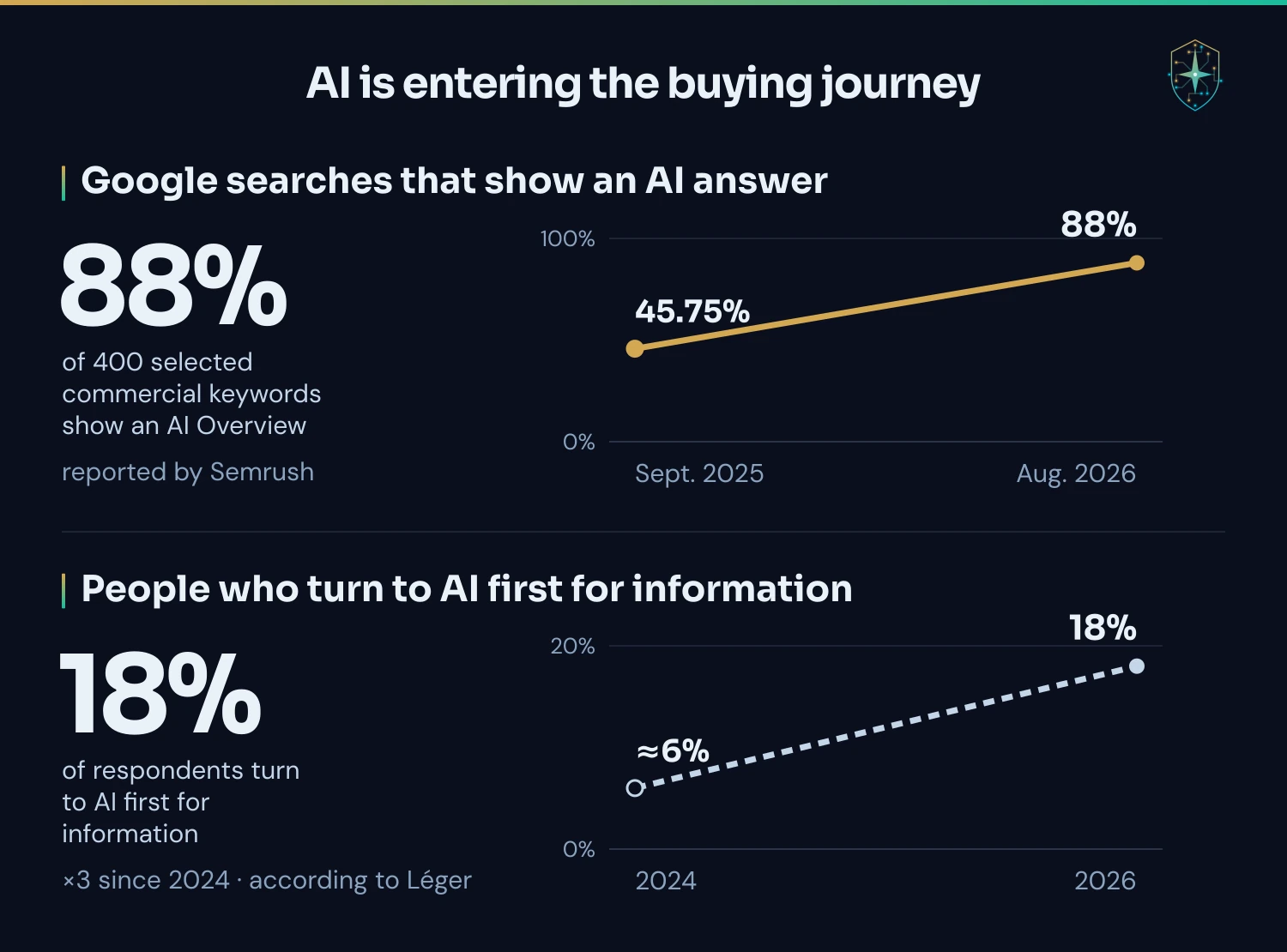
In Canada, Léger also reports a change in where people start: 18% of Canadians turn to AI first when looking for information online, a proportion that has tripled since 2024. That measure covers more than shopping, but it shows assistants becoming a familiar starting point.
Google remains widely used. The shift is happening within particular steps: asking for advice, establishing criteria and narrowing the options. A customer can still buy in a store or on a website after preparing the decision somewhere else.
From advice to a shortlist
Consider a hypothetical example. A manager wants AI training for an administrative team. She asks an assistant: “What kind of training would help us reduce repetitive tasks?” Then: “Compare the formats and suggest providers in Chicoutimi.”
The conversation helps her clarify the need, discover options and prepare her next questions. Someone buying a product could use the same approach to compare computers against a specific budget and set of tasks.
In this journey, AI takes on some of the recommendation work previously handled by search results, reviews, buying guides or a salesperson. Businesses have a reason to understand what customers encounter during that stage, before the first inquiry arrives.
Google Search is changing too
AI Overviews, the generated summaries within Google’s results, also bring answers into the familiar search journey.
In the United States, Semrush tracked 400 commercial keywords involving comparisons, reviews, pricing and alternatives across banking, software and ecommerce. The share showing an AI Overview rose from 45.75% in September 2025 to 88% in August 2026. This panel concerns purchase research; it does not represent every local service search.
Those answers can also change the next visit. In a separate U.S. study, Pew observed a click on a traditional result after 8% of result pages with an AI summary, compared with 15% without one. That observation covers several kinds of searches and does not measure sales.
See the choice through your customer’s eyes
Choose a real question customers ask before buying and ask an assistant to compare the options. Look at the businesses suggested, the criteria used and the sources cited. Is your offer described accurately? Can someone find the information needed to make a decision?
Save the answer and its date. This first check can reveal a specific correction to make, without providing a complete measure of your visibility.
To examine the public information on your website, you can try Breach for free. The assessment checks your public foundations; it does not test assistant recommendations.
Sources and methodology
Leger · Forrester · Semrush · Pew
Léger, published October 14, 2026: online survey of 1,511 Canadians aged 16 and over, May 22 to June 1, 2026. The 25% and 46% figures concern AI users; the 18% concerns Canadians surveyed. These are self-reported behaviours.
Forrester, public summary dated April 7, 2026: U.S. online adults reporting ChatGPT use in the previous month to research products they were interested in buying; 19% in October 2025, 26% in February 2026. Channels can overlap. The summary also reports Google at 71% and Amazon at 54% in February. Sample sizes and full methodology are unavailable in the summary; the paid report was not purchased. No equivalent Canadian time series or service-specific increase is established here.
Semrush, published October 21, 2026: the same 400 selected commercial keywords across banking, software and ecommerce, U.S. desktop results. AI Overview coverage rose from 45.75% in September 2025 to 88% in August 2026. This measures presence, not human queries, clicks, recommendations or purchases.
Pew, published July 22, 2025: browsing by 900 U.S. adults in March 2025, results reconstructed April 7–17. The 8% and 15% refer to result-page visits followed by a traditional-result click, not people or sales. Findings are not shopping-specific and do not establish causation.
Graphic: the panels use different populations, units and scales. Léger’s approximate 6% point for 2024 is calculated from the reported tripling: 18% ÷ 3. It is not a separately published baseline; the dashed line indicates that estimate. Country names are omitted from the graphic at Dominic’s request; Semrush covers the United States and Léger covers Canada. Lines connect two points without displaying intermediate observations.
The training example is hypothetical. The interpretation about some decision steps shifting is editorial synthesis: these findings do not measure individual abandonment of Google, salespeople or stores, or sales attributed to AI.