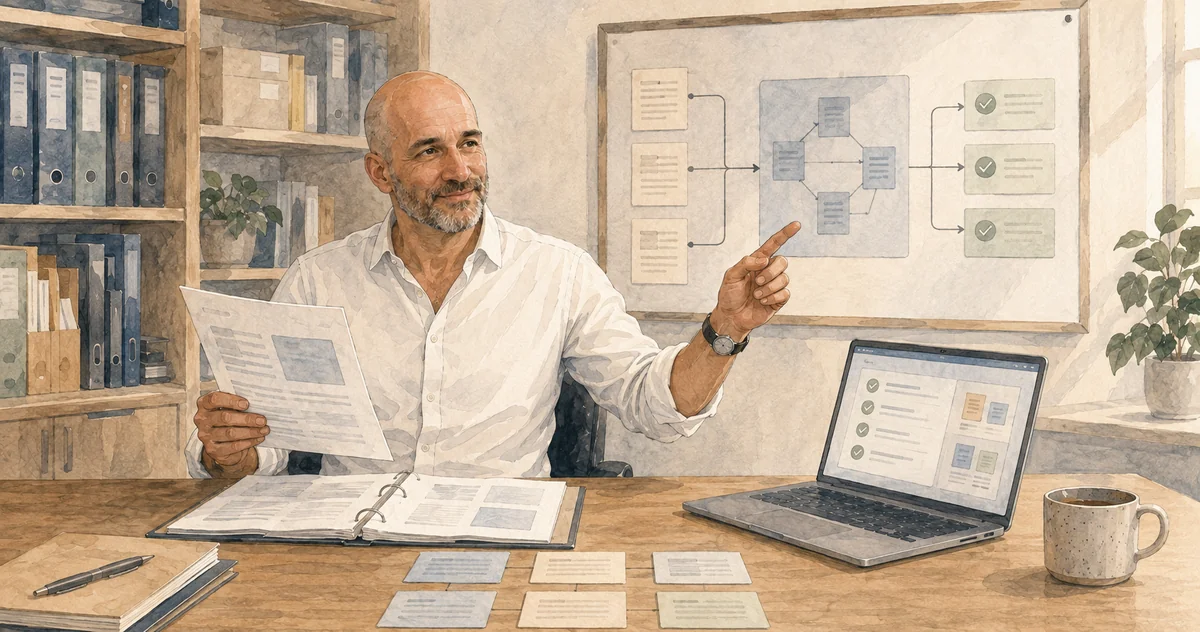
Your company already has a knowledge base. It just may not work like one.
It is spread across shared drives, email threads, meeting notes, project tools, chat histories, employee laptops, and the memories of the people who have been there the longest. The knowledge exists. The problem is that it is difficult to find, hard to verify, and easy to lose.
That risk becomes visible when a key employee retires or leaves. The organization may keep the files and still lose the reasoning behind them: why an exception exists, which workaround prevents a recurring failure, what a client was promised, which supplier relationship needs special care, or why a decision that now looks strange was sensible at the time.
This is corporate amnesia: the gradual loss of operational memory as people, roles, systems, and priorities change. Retirement makes the risk obvious, but it can also follow a resignation, promotion, parental leave, restructuring, acquisition, or long absence.
A useful company knowledge base reduces that risk. It does more than store documents. It gives the organization a dependable way to preserve what it knows, retrieve the right information, and turn accumulated evidence into better action.
Corporate amnesia is a succession risk
Succession planning often focuses on replacing a role. Knowledge continuity asks a different question: what does the next person need to understand in order to make sound decisions?
A job description rarely contains the full answer. The most valuable knowledge is often embedded in experience:
- the reason a process was designed a certain way;
- the warning signs an experienced operator notices early;
- the informal dependencies between teams, clients, and suppliers;
- the exceptions that are safe and the ones that create risk;
- the approaches that were tried before and why they failed;
- the context behind commitments, approvals, and long-running relationships.
No database can capture every instinct or replace mentoring. The goal is not to turn experienced people into documents. It is to create enough continuity that their departure does not force the company to relearn avoidable lessons from zero.
A knowledge base is not one application
At Nord Paradigm, we eventually stopped trying to make one tool do every job.
Our company knowledge includes operating notes, decisions, market intelligence, research, project history, lessons learned, and reusable strategic material. Some of it must remain easy for a person to read. Some of it must be searchable by meaning rather than filename. Some of it needs to be compiled into structured research without losing the path back to the original evidence.
Those are three different jobs. The model that emerged has three layers:
- A human-readable source of truth.
- A semantic retrieval layer.
- A structured research layer.
The technology can vary. The separation of responsibilities is what matters.
Layer one: preserve the source of truth
The first layer contains the canonical records: material people can open, read, edit, review, and archive without depending on a specialized AI system.
This is where decisions, policies, project notes, research sources, operating procedures, relationship context, and lessons learned should live. Each important subject needs an identifiable home. When two versions conflict, the organization must know which one is authoritative.
Human readability matters. If the retrieval system disappears tomorrow, the company should still own and understand its knowledge. If an employee needs to verify an answer, there should be a source record behind it. If a policy changes, someone should be able to update the canonical version instead of chasing copies through five tools.
This layer creates continuity. People can change roles, projects can pause, and software can be replaced without erasing the organization’s memory. It also reinforces a broader principle: the durable asset is the knowledge and data the company owns, not the model or application used to search it.
Layer two: retrieve the right knowledge
A well-organized archive can still be slow to use. People do not always remember the exact filename, folder, project code, or wording used six months earlier.
That is where semantic retrieval becomes useful. Instead of searching only for matching words, a semantic layer can retrieve material related to the meaning of a question.
Someone can ask:
- What did we decide about this market?
- What objections have we heard from this type of buyer?
- Which risks have appeared across similar projects?
- What evidence supports this recommendation?
- What did the previous account lead say about this relationship?
The retrieval layer should not become a second source of truth. Its job is to find relevant knowledge and point back to the canonical records. Search can be fast without becoming authoritative.
When this layer works well, meeting preparation becomes faster, previous work becomes reusable, and teams spend less time asking where something was saved. The same distinction matters for public content: information can be readable by AI without being reliable enough to cite.
Layer three: turn evidence into structured intelligence
Some questions require more than finding an old note. They require comparing sources, identifying patterns, reconciling contradictions, and producing a maintained body of research.
A structured research workspace can separate raw sources from compiled explanations and final outputs. It can preserve citations, show what has been reviewed, and make gaps visible. Instead of treating every report as a disconnected deliverable, the organization builds a research asset that improves as new evidence arrives.
This is especially useful for market intelligence, competitive analysis, regulatory monitoring, implementation patterns, product strategy, and recurring client questions.
The result is not simply more content. It is a better chain of reasoning from evidence to recommendation.
What this can do for a company
Preserve institutional memory
Important knowledge stops living exclusively in a founder’s head or with one experienced employee. The organization retains the reasons behind decisions, not only the final decision.
Make retirements and departures less disruptive
Knowledge transfer can begin before the farewell lunch. Successors can review decisions, examples, relationship history, unresolved questions, and lessons while the departing expert is still available to correct what was captured.
Improve onboarding
New employees can learn how the company actually operates from maintained records, examples, decisions, and lessons. They do not need to reconstruct the business through scattered conversations.
Support faster, more consistent decisions
Teams can find previous assumptions, evidence, and outcomes before making the next decision. This reduces avoidable repetition and makes contradictions easier to spot.
Strengthen sales and client service
Meeting history, common objections, approved explanations, service knowledge, and sector research can be retrieved when needed. The goal is not to automate the relationship. It is to help people enter the conversation with better context.
Make governance practical
Policies, responsibilities, approvals, sources, and decision records become easier to locate and review. ISO 30401 treats knowledge management as an organizational management system, not merely a document repository. The same discipline supports practical AI governance: the NIST AI Risk Management Framework emphasizes documentation, defined responsibilities, knowledge limits, and human oversight.
Give AI a better foundation
An AI assistant connected to poorly governed information will retrieve poorly governed information faster. A knowledge base does not make AI truthful by itself.
What it can provide is a controlled foundation: known sources, clearer ownership, better context, traceability, and a path for human verification. OECD AI principles similarly connect accountability with traceability across data, processes, and decisions.
Why a shared drive is not enough
A shared drive answers one question: where can files be stored?
A functioning knowledge base must answer several more:
- Which record is authoritative?
- Who owns it?
- When was it last reviewed?
- Who is allowed to see it?
- What decision or evidence does it support?
- What replaces it when it becomes outdated?
- Can a person or system trace an answer back to the source?
Without those answers, the company has storage but not dependable organizational memory. The same problem appears when everything is placed into an AI search tool without preparation. Duplicate files, obsolete policies, draft material, and sensitive client information do not become trustworthy because they were indexed.
How to start before key people leave
Do not begin by importing every file the company has ever produced. Start where knowledge loss would hurt most.
- Identify roles, relationships, and processes with a high concentration of undocumented knowledge.
- Choose one or two high-value areas, such as sales knowledge, operations, product decisions, regulatory research, or client-delivery lessons.
- Record not just what happens, but why decisions, exceptions, and workarounds exist.
- Assign an owner and review cycle to the canonical records.
- Separate current material from archives and drafts.
- Define access, privacy, and retention rules before connecting AI.
- Add retrieval only after the source layer is understandable.
- Test the records with the people who rely on the knowledge and with the people preparing to hand it over.
Useful measures can be simple: time required to prepare for a meeting, repeated questions, outdated answers discovered, onboarding friction, critical processes with a documented backup, or the percentage of important recommendations that can be traced to current evidence.
The real asset is not the tool
Tools will change. Search models will improve. AI assistants will come and go. Employees will retire, accept new opportunities, or move into different roles.
The durable asset is the company’s organized knowledge: its decisions, evidence, context, methods, relationships, and lessons, maintained in a form that people can understand and systems can use responsibly.
A good company knowledge base does not try to remember everything. It makes the knowledge that matters dependable, retrievable, transferable, and reusable.
That is how an organization learns faster than it forgets.