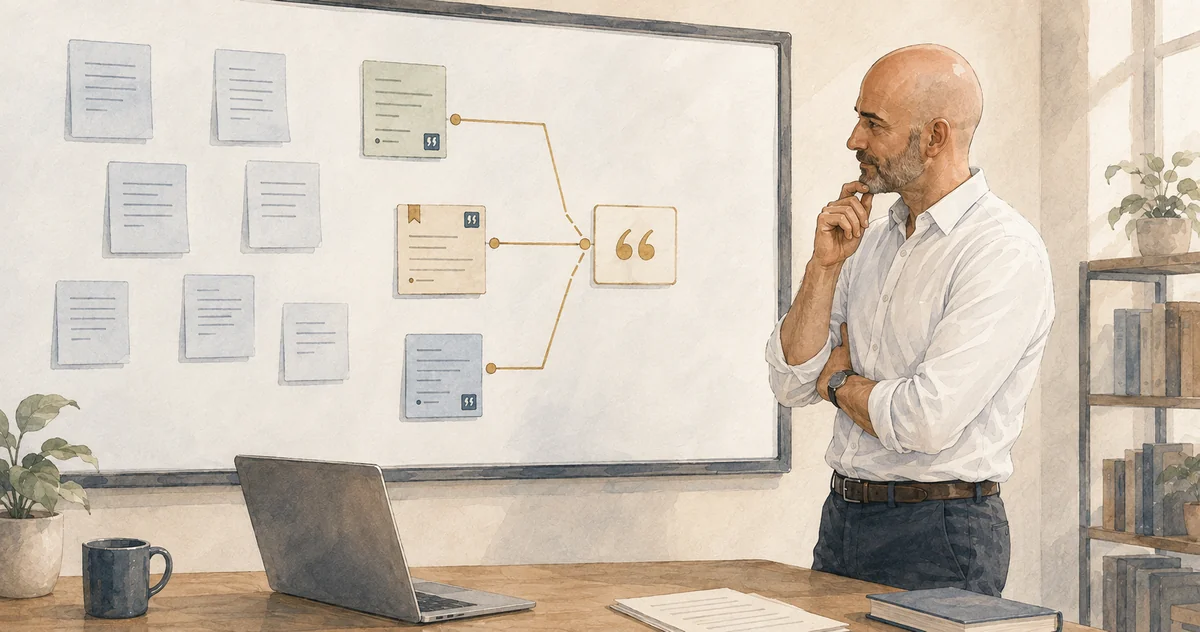
Many Canadian SMBs are starting to ask the right question about AI search: can ChatGPT, Claude, Gemini, Perplexity, and other answer engines understand what we do?
That question is important, but it is only the first layer. A page can be readable by AI and still not be citable. Readable means the system can access and parse the words. Citable means the system has enough public proof to trust the claim, connect it to your business, and use it in an answer.
Readable is access. Citable is evidence.
Readable content is usually about technical access and structure. Can crawlers reach the page? Is the page rendered clearly? Does the content say what the business does in plain language?
Citable content goes further. It gives an answer engine a stable source, a clear claim, a named service, a geographic or market context, and enough supporting detail to make the claim worth repeating. This is where many SMB websites fall short. They describe themselves in marketing language, but they do not give AI systems the evidence needed to explain them confidently.
Why this matters for Canadian SMBs
Most buyers no longer compare vendors only through search results. They ask AI systems for shortlists, summaries, risks, differences, and recommendations. If your public content is vague, thin, or disconnected, the answer may skip you even when your service is relevant.
This is not only an SEO issue. It affects referrals, analyst-style comparisons, vendor research, and sales conversations. The same public proof that helps AI systems cite you also helps a human prospect decide whether you are credible.
Common signs your content is readable but not citable
You may have this gap if your website has broad claims but little proof behind them:
- Your service pages say what you offer, but not who it is for, what problem it solves, or what outcome it supports.
- Your expertise is implied through tone, but not supported by specific credentials, examples, process, or methodology.
- Your pages use interchangeable phrases like "innovative solutions" or "trusted partner" without concrete detail.
- Your blog posts explain ideas, but do not connect them back to your services, market, or buyer questions.
- Your English and French pages do not carry the same level of evidence, making one language weaker as a source.
What makes a page easier to cite
A citable page does not need to be long. It needs to be specific. It should answer the questions an AI system, buyer, journalist, partner, or analyst would ask before repeating a claim.
For a Canadian SMB, that usually means naming the service, the customer profile, the operating context, the relevant constraints, and the proof. If the service touches AI, privacy, governance, security, professional advice, regulated work, or public trust, the page should explain how decisions are reviewed and what evidence supports them.
Strong citation signals include clear headings, internal links, source links where appropriate, author context, dated updates, consistent terminology, and pages that state the business model plainly. An answer engine should not have to guess what you do.
The practical audit
Start with five pages: your homepage, your main service page, your about page, your strongest proof page, and your most relevant article. For each one, ask:
- What claim would we want an AI system to repeat about this page?
- Is that claim stated clearly in the page text?
- Is there enough proof for the claim to feel reliable?
- Does the page link to the next piece of evidence?
- Would the claim still make sense if quoted outside the page?
If the answer is no, the page is probably readable but not citable. The fix is not more keyword stuffing. It is better public evidence.
Illustrative example: turn a vague promise into verifiable evidence
The following example is fictional. It shows the structure of a stronger answer; it does not describe a real client or promise results.
Buyer question: Which Quebec machine shop can produce a small batch of stainless-steel parts for a food plant?
Vague passage:
“We provide innovative, fast manufacturing solutions tailored to your needs.”
Missing evidence: the steel grades handled, batch sizes, service area, food-sector constraints, and dated proof of comparable work.
Improved passage:
“Fictional example: Boreal Machine Works produces batches of 10 to 200 stainless-steel 304 and 316 parts in Quebec for food processors. Its dated project page shows a comparable batch, the material certificates provided, the dimensional checks performed, and the limits of the engagement.”
Next action: verify every detail against your quotes, quality records, certifications, or case studies before publishing it, then link each claim to that evidence. To see how this type of gap appears in a deliverable, review the Breach Pro report example.
What to fix first
Do not rewrite the whole website at once. Start with the pages most likely to be used as sources. Strengthen the claims, remove vague language, add concrete context, and connect the pages together.
For most SMBs, the first useful move is a citation-readiness pass: align the homepage, services, proof, FAQ, and one article around the same buyer question. Then make sure the content is technically accessible through the sitemap, internal links, and crawler settings.
To find out whether AI recommends your business or your competitors, explore Breach Pro. The audit tests buyer questions in ChatGPT, Gemini, and Claude and recommends priority fixes. The included debrief helps your team put the plan into practice. Its public methodology explains how mentions, citations, source visibility, and limits are documented. You can also review the founder’s audit and implementation background.
The better question
The better question is not only: "Can AI read our content?"
It is: "If an AI system had to explain why a buyer should trust us, what public proof could it cite?"
If that proof is missing, AI visibility will stay fragile, even when the site is technically readable.