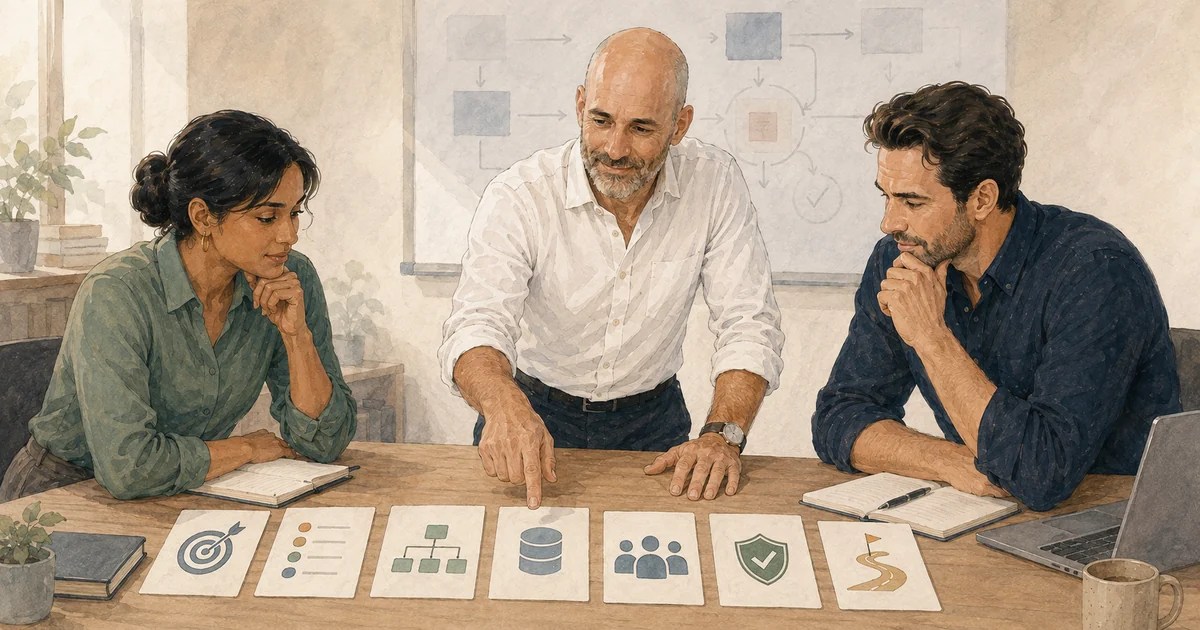
An AI readiness assessment checks whether your team, data and workflows can support a useful, controlled AI implementation. Expect seven deliverables: a measurable outcome, prioritized workflows, a current-process map, a data assessment, clear responsibilities, controls and a 90-day roadmap.
Use this checklist to compare a proposal or prepare an AI pilot with clear success criteria. Our AI implementation approach explains how that preparation can lead to one useful working process.
An AI maturity score does not tell you what to do on Monday morning.
A company can receive a polished report saying it is “62% ready” and still have no idea which workflow to improve, what information can be used, who owns the decision or how success will be measured.
That distinction matters as AI use grows. Statistics Canada reported that 19.2% of Canadian businesses used AI to produce goods or deliver services during the 12 months preceding its second-quarter 2026 survey, up from 6.1% in the comparable 2024 survey. Adoption is moving faster, but the practical questions remain stubbornly operational: Where should we start? What can our team support? What evidence would justify a larger investment?
It should not end with a catalogue of tools. It should end with decisions, owners, evidence and a short execution queue.
Readiness assessment, governance audit or implementation engagement?
These three activities can support one another, but they answer different questions.
| Activity | Main question | Useful outcome |
|---|---|---|
| AI readiness assessment | Where can this organization start responsibly and create measurable value? | A qualified first workflow and a bounded execution roadmap |
| AI governance audit | Are the organization’s policies, controls and evidence adequate for its AI risks and obligations? | Documented gaps, risk priorities and a governance remediation plan |
| AI implementation engagement | Can the selected workflow be redesigned, built, tested and adopted in daily operations? | A working process with acceptance criteria, ownership and monitoring |
A readiness assessment can reveal that a governance issue must be addressed before implementation. It can also show that a promising idea is not ready because the underlying process is inconsistent or its information sources are unreliable.
That is a useful result. Readiness is not about forcing every idea into production. It is about making a better next decision.
1. A measurable business outcome
The assessment should begin with a business problem, not an AI feature.
“Use generative AI” is not an outcome. “Reduce the time required to prepare a first draft of a customer proposal while preserving human approval” is much closer. It names a process, a result and an important boundary.
A useful outcome statement should identify:
- the current baseline;
- the desired improvement;
- the people affected;
- the quality level that must be preserved;
- and the evidence that would demonstrate progress.
The baseline does not need to be perfect. A representative sample of time spent, rework, delays and errors is often enough to begin.
Without that baseline, the project can produce an impressive demonstration without proving that the business is better off.
2. A prioritized shortlist of workflows
Most businesses have more AI ideas than they can execute.
A readiness assessment should narrow the field to a small number of workflows and rank them using practical criteria:
- business value;
- frequency and volume;
- process stability;
- information availability;
- implementation effort;
- privacy and security exposure;
- consequences of an incorrect output;
- and time required to collect useful evidence.
This prevents the loudest request or newest product demo from becoming the default priority.
The best first workflow is often repetitive enough to measure, bounded enough to control and important enough that employees will notice the improvement.
The deliverable should explain why the leading workflow was selected and why the others were deferred.
3. A map of the current process
AI cannot repair a process that nobody understands.
Before recommending automation, the assessment should show how the work happens today:
- where the request begins;
- which steps are performed;
- who makes each decision;
- where information is copied or re-entered;
- which exceptions require judgment;
- where work waits;
- and what final approval looks like.
This map is not busywork. It often reveals that the apparent “AI problem” is a handoff, ownership or documentation problem.
Proposal preparation may look like a writing task. The real delay may come from finding approved service descriptions, confirming prices and verifying claims. A writing assistant alone will not solve that system.
4. A data and knowledge-source assessment
Every useful AI workflow depends on information.
The assessment should identify the systems, documents and records the workflow needs, then answer:
- Who owns each source?
- Is it current?
- Is it complete enough for the task?
- Which version is authoritative?
- Who may access it?
- Does it contain personal, confidential or licensed information?
- Can an output point back to the source that supports it?
This is where many attractive ideas become more realistic. A team may have hundreds of documents but no dependable source of truth. Policies may conflict. Customer information may sit in email threads. Product details may be current on one person’s laptop and obsolete everywhere else.
That does not mean the company is “not ready for AI.” It means the first implementation step may be to improve the knowledge base, permissions or document ownership. I explain this broader foundation in Why a Company Knowledge Base Becomes Business Infrastructure.
A strong assessment separates information that can be used now from information that must be cleaned, governed or excluded.
5. A people and accountability map
An AI project needs more than an executive sponsor and a technical vendor.
The readiness assessment should identify:
- the process owner;
- the employees who perform the work;
- the subject-matter expert who can judge output quality;
- the person responsible for access and security decisions;
- the people affected by the redesigned workflow;
- the training required;
- and the escalation path when the system is uncertain or wrong.
The process owner is especially important. This person does not need to build the technology, but they must be able to decide whether the workflow is working and whether changes are acceptable.
Employees often know which exceptions matter and which mistakes would damage trust. Canada’s SME deployment guidance also recognizes smaller firms’ limits on expertise, time and governance capacity. The operating model must fit the team that actually exists.
6. A risk and control register
Risk should be tied to the selected workflow, not copied from a generic AI checklist.
A proposal assistant and an automated hiring recommendation do not create the same exposure. The assessment should document the relevant risks, their likely impact and the controls required before the workflow proceeds.
Depending on the use case, the register may cover:
- privacy and personal information;
- confidential business information;
- access control;
- unreliable or fabricated outputs;
- biased decisions;
- cybersecurity;
- vendor dependence and data use;
- intellectual property;
- service continuity;
- human review;
- and recordkeeping.
Each significant risk should have an owner, a treatment and a no-go condition. “A human will review it” is not enough unless the review point, reviewer, standard and evidence are defined.
Frameworks can help organize this work. The voluntary NIST AI Risk Management Framework uses the functions Govern, Map, Measure and Manage. ISO/IEC 42001 provides requirements for an AI management system. Neither should be pasted wholesale into a small project. The assessment should borrow the level of discipline that fits the workflow, the organization and the risks.
For organizations moving toward a formal management system, Nord Paradigm’s ISO/IEC 42001 implementation and readiness support is the deeper path.
7. A 90-day execution roadmap
The final deliverable should convert the assessment into a controlled sequence of work.
A useful roadmap names:
- the selected workflow;
- the owner and participating team;
- the first version’s scope;
- information sources and access boundaries;
- acceptance criteria;
- controls and human review;
- evidence to collect;
- checkpoints;
- and a go, revise or stop decision.
The roadmap should also state what is deliberately outside the first 90 days. Scope is a readiness control.
One practical sequence might look like this:
Days 1–30: establish the operating baseline
Confirm the process, examples, sources, permissions, quality criteria and risks.
Days 31–60: build and test a bounded workflow
Create the smallest useful version, test it on historical or low-risk cases, and record failures, exceptions and reviewer effort.
Days 61–90: run it under controlled operating conditions
Introduce it to a limited group, compare results with the baseline and decide whether to expand, revise or stop.
This is the bridge between a successful demonstration and daily work. As explained in Why AI Pilots Stall Before They Reach Daily Operations, possibility is not the same as repeatability, responsibility and evidence.
A practical example: quote and proposal preparation
Consider a 40-person professional-services company that wants to prepare proposals faster.
A weak assessment recommends a writing tool and estimates that employees could save several hours per week.
A strong assessment produces:
- Outcome: reduce first-draft preparation time while keeping pricing and final claims under human approval.
- Workflow shortlist: compare proposal drafting with two other candidate processes and explain why proposals lead.
- Process map: show intake, qualification, solution design, pricing, drafting, review and approval.
- Knowledge sources: identify approved service descriptions, case examples, contract language and current pricing ownership.
- Accountability: name the sales-process owner, subject-matter reviewers and final approver.
- Controls: exclude confidential client material unless approved, require source-linked claims and prevent automated sending.
- Roadmap: test on a bounded proposal type, measure draft time and correction rates, then make a go/no-go decision.
The result is not “the company is ready for AI.” The result is more useful: this workflow is ready for a controlled implementation under these conditions.
Red flags in a weak readiness assessment
| Strong deliverable | Weak substitute |
|---|---|
| Measured operational outcome | General promise of productivity |
| Ranked workflow with rationale | Long list of possible use cases |
| Current-state process evidence | Assumptions from leadership interviews alone |
| Named source owners and access rules | “Connect the company’s data” |
| Accountable process owner | Vague executive sponsorship |
| Use-case-specific controls | Generic responsible-AI checklist |
| Sequenced 90-day decision path | Technology shopping list |
If the assessment cannot tell you what to start, who owns it, what information it may use and how you will decide whether it worked, it has not reduced enough uncertainty.
Frequently asked questions
What is an AI readiness assessment?
An AI readiness assessment is a structured review of whether a specific workflow, team, information base and control environment can support a useful AI implementation. It should identify a qualified starting point, its conditions and the evidence required to proceed.
Is an AI maturity score useful?
It can provide a high-level comparison, but it is not enough to guide implementation. A business still needs a measurable outcome, process evidence, source ownership, accountable people, controls and an execution roadmap.
How is an AI readiness assessment different from an AI audit?
A readiness assessment asks where the organization can begin and what must be true for implementation to succeed. An AI governance audit examines policies, controls, risks and evidence against defined obligations or frameworks. The two may overlap, but they produce different decisions.
What should happen after the assessment?
The company should select one bounded workflow, confirm its owner and controls, establish acceptance criteria and test it under limited conditions. The next step may be implementation, governance remediation, knowledge-source cleanup or a deliberate decision not to proceed.
Turn readiness into one working process
The purpose of readiness is not to admire the plan. It is to make a better implementation decision.
Nord Paradigm’s AI Implementation Partnership helps Canadian SMBs turn one recurring bottleneck into a workflow the team can actually use. If you already have a process in mind, book a 20-minute discovery call and bring the current version, including the messy parts.
Sources and further reading
- Statistics Canada — Analysis on artificial intelligence use by businesses in Canada, second quarter of 2026
- Innovation, Science and Economic Development Canada — Toolkit for SMEs deploying artificial intelligence
- Innovation, Science and Economic Development Canada — Canada’s National Artificial Intelligence Strategy: AI for All
- NIST — AI Risk Management Framework
- ISO — ISO/IEC 42001:2023 AI management systems