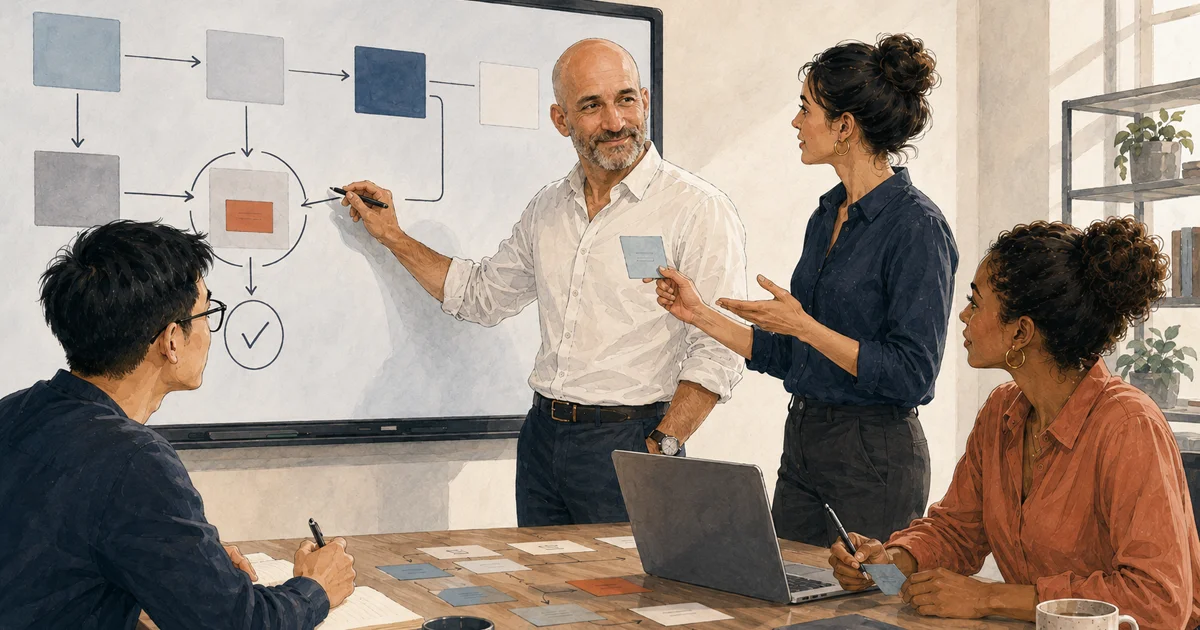
A useful AI workshop should change what a team can do, not only what it knows about the tools.
By the end of the session, participants should understand which parts of their work are worth improving, have practised a few methods on realistic examples, know where human judgment still belongs, and have something they can reuse afterward. If the main thing people remember is an impressive demonstration, the workshop has not yet connected AI to their work.
I enjoy running AI workshops because the most useful moments rarely come from the polished demonstration. They begin when someone says, “We do this every week, and it takes far too long.” That is when the group can stop looking at AI from a distance and start examining what it could change in a real situation.
A demonstration creates interest. A working session builds capability.
Demonstrations have a place in an AI workshop. They help people see what is possible and give the group a common starting point.
But a demonstration is controlled. The example is prepared, the inputs are clean, and the presenter already knows the desired result. Work is rarely that tidy. Employees deal with incomplete information, changing requirements, sensitive material, unclear requests, and results that need to be checked before anyone relies on them.
A working session introduces that reality. Participants do not simply watch someone produce a strong answer. They help define the task, provide the relevant context, try an approach, inspect the result, and decide what would need to change before the method could be used again.
That shift from watching to working is what makes the workshop useful.
The workshop should begin before the team meets
Customization is not adding the company logo to a generic presentation. It begins by understanding what the team actually does.
Before the workshop, I like to collect examples of tasks that feel irritating, repetitive, or unnecessarily long. The objective is not to promise that AI can solve all of them. It is to identify a small number of situations that can support useful learning.
For each candidate, it helps to ask:
- Who performs the task, and how often?
- What information is available at the beginning?
- What should a good result contain?
- Which parts require experience or judgment?
- Does the work involve confidential or sensitive information?
- What tools can the participants actually use?
This preparation makes the session relevant before the first slide appears. It also prevents the workshop from becoming a rushed collection of disconnected prompts.
Use realistic work without creating unnecessary risk
Realistic examples matter because generic examples hide the difficult parts of a task. “Summarize this document” sounds simple until the team has to decide which details matter, what cannot be omitted, who will use the summary, and how the result must be verified.
That does not mean a workshop should expose client records, employee information, confidential strategies, or other sensitive material. Examples can be de-identified, simplified, or recreated while preserving the structure of the work.
The important question is whether the exercise reflects the decisions participants normally have to make. A realistic exercise should reveal where context is missing, where the model makes assumptions, and where a person must review the result.
One useful workshop output is therefore a short, prioritized map of the work the team wants to improve, including the opportunities that are suitable for practice and the ones that should not be attempted without more preparation.
Teach methods that survive the next interface update
AI tools evolve quickly. A workshop built entirely around the location of buttons can become dated soon after it is delivered.
The more durable approach is to begin with the task and then choose the tool. Claude, ChatGPT, and other platforms can each be useful, but the decision should depend on the work, the available features, the organization’s constraints, and the experience of the participants.
The transferable skill is not memorizing one perfect prompt. It is learning how to:
- define the result clearly;
- provide the right context and source material;
- separate instructions from reference information;
- recognize when the answer is incomplete;
- improve the request through a second pass; and
- verify the result before using it.
An introductory workshop may focus on one platform to keep the learning manageable. A follow-up workshop should normally go further. It can compare different approaches and help the team become less dependent on any one interface.
Participants should do the work themselves
The facilitator should not be the only person using the tool.
Watching an experienced user work can make AI look easier than it is. The facilitator already knows how much context to provide, which instructions are likely to help, and when the output is starting to drift. Participants need an opportunity to develop that judgment themselves.
During a useful workshop, they should build a first attempt, compare results, identify what went wrong, and revise the method. The discussion around a weak result is often more valuable than another flawless demonstration.
For each use case, the group can leave with a simple working method:
- When the method should be used.
- What information it needs.
- The steps to follow.
- What an acceptable result looks like.
- What must be checked by a person.
- When to stop and use another approach.
That is more useful than a prompt copied without the reasoning that supports it.
Human checkpoints belong inside the method
Responsible use should not be a separate warning delivered at the end of the workshop. It should be visible in every exercise.
If the team uses AI to prepare a document, someone still needs to confirm the facts, tone, audience, and final decision. If the tool helps classify requests, the group should define which cases can follow the normal path and which ones must be escalated. If sensitive information is involved, participants need a clear boundary before they begin.
The workshop should help the team answer four practical questions:
- What information may be used?
- What must be reviewed?
- Who remains responsible for the decision?
- What action should never happen automatically?
These checkpoints do not make the exercise less practical. They make the resulting method usable in a real organization.
Prompts alone are not a handover
A prompt can be helpful, but it is rarely enough on its own. Without the right context, examples, review criteria, and explanation of when to use it, even a strong prompt becomes fragile.
After the workshop, the team should have one place where it can find the material developed during the session. Depending on the workshop, that may include:
- the prompts and methods that were tested;
- the examples used during the exercises;
- a concise reference sheet;
- notes about which tool fits which situation;
- reminders about sensitive information and human review; and
- useful resources for continued learning.
The objective is not to create a large library that nobody opens. It is to preserve the small number of resources the team is most likely to reuse.
Before people leave, decide what happens next
A workshop can create momentum, but it is not the same thing as implementing an AI-enabled process.
Before the session ends, the group should choose one or two limited experiments for the following weeks. Each experiment needs an owner, a situation in which it will be tested, and a few observations to collect. What worked? What required correction? Where did the method save effort, and where did it create more work?
This creates a practical next step without pretending that one workshop will transform every process in the organization.
If the team later wants to integrate a method into its systems, automate part of a workflow, or measure operational gains, that becomes a separate implementation discussion. The workshop helps people identify and understand the opportunity first.
A second workshop should not repeat the first one
The team’s needs change once people have started using AI.
An introductory workshop may need to establish basic habits: giving context, writing useful instructions, checking results, and protecting sensitive information. In a follow-up session, participants arrive with experience. They have examples of what worked, questions created by real use, and situations where the first method was not enough.
The next workshop should build on that maturity. It might compare Claude and ChatGPT for different tasks, improve methods the team already uses, work with longer documents, or examine where a repeatable process could replace improvised prompting.
The subject is no longer simply how to use an AI tool. It is how to use AI more deliberately in the team’s work.
How to recognize a genuinely customized AI workshop
Before booking a workshop, ask what will happen before, during, and after the session:
- Will the facilitator collect real tasks and questions in advance?
- Will the exercises reflect the participants’ work and experience level?
- Will participants use the tools themselves?
- Will the workshop address sensitive information and human review?
- Will the team receive reusable material afterward?
- Will the session end with a realistic next step?
A useful workshop does not need to solve every problem. It should help the team understand where AI fits, practise a few methods that reflect its reality, and leave better equipped to continue.
That is the kind of workshop I like to run: one where the team leaves talking about its work, not only about the software.
What should your team be able to do with AI?
Nord Paradigm offers custom AI workshops for businesses, in English or French, online or in person. Each workshop is prepared around the participants, the tools they use, and the work they want to improve.
Discuss a custom AI workshop built around the work your team actually does.
Listen to the discussion (in French)
Watch the discussion on YouTube (4 min 35)
For an example of these principles translated into practical resources, read our case study of a Claude workshop prepared for a marketing agency.